A Digital Due Diligence Perspective on the World’s Top Brands
This article examines how the world’s most valuable brands reveal their true competitive strength when viewed through digital due diligence.
Lóránt Erős
Digital Strategist
Although traditional rankings evaluate overall brand value, the digital portion of that value is rarely explored with equal depth. This article is part of our broader Digital Due Diligence (DDD) series, offering only a small fraction of what a full DDD assessment uncovers. The intention is to demonstrate how structured digital analysis helps interpret and ultimately quantify the digital brand value.
To anchor the analysis, we define digital brand value as the part of a brand’s financial value driven by its digital brand assets (such as digital visibility, trust signals, sentiment, and market penetration) alongside its technological assets (including its internal technology stack, scalability, and digital processes).
This becomes the guiding lens for understanding what truly differentiates the world’s top brands in 2025.
The report analyzes the Top 10 Global Brands as identified by Interbrand’s Best Global Brands 2024 ranking. The Digital Due Diligence assessment includes the following brands: Apple, Microsoft, Amazon, Google, Samsung, Toyota, Coca-Cola, Mercedes-Benz, McDonald’s, and BMW.
A Social Ecosystem Still Driven by Scale
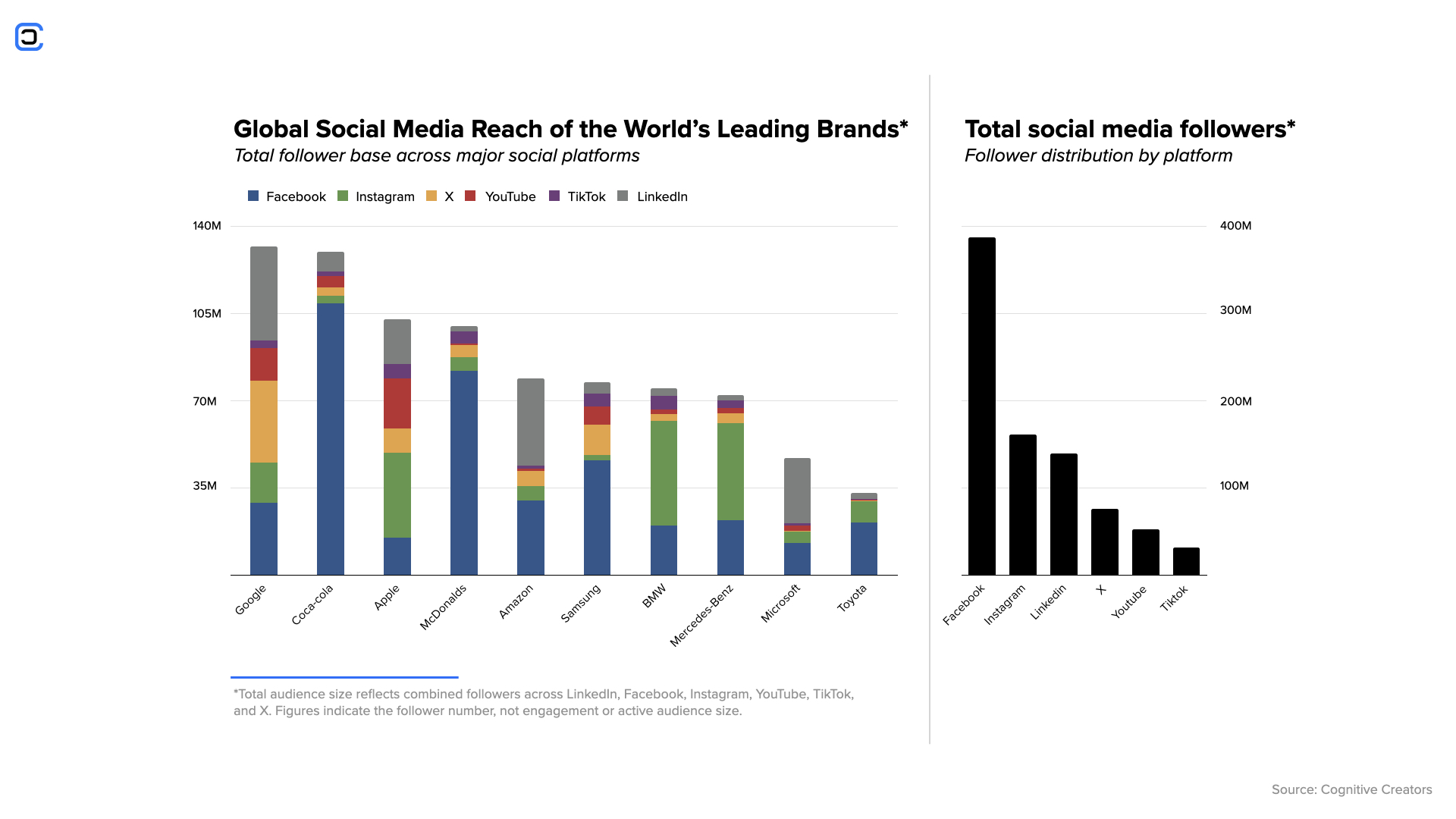
Social platforms reveal that top brands maintain enormous reach across generations and geographies. Facebook still holds the largest concentration of followers, far outpacing newer platforms. This reinforces one intuitive expectation: global brands attract global audiences.
But the twist comes when we ask what this visibility actually means. Large follower bases indicate strong salience, but they don’t tell us how people discover a brand or interact with it in moments of need.
The implication: social visibility expands reach, but it does not explain digital competitiveness on its own. To understand that, we need to follow the user journey into search and web experience.
Website Performance as The First Layer of Digital Trust
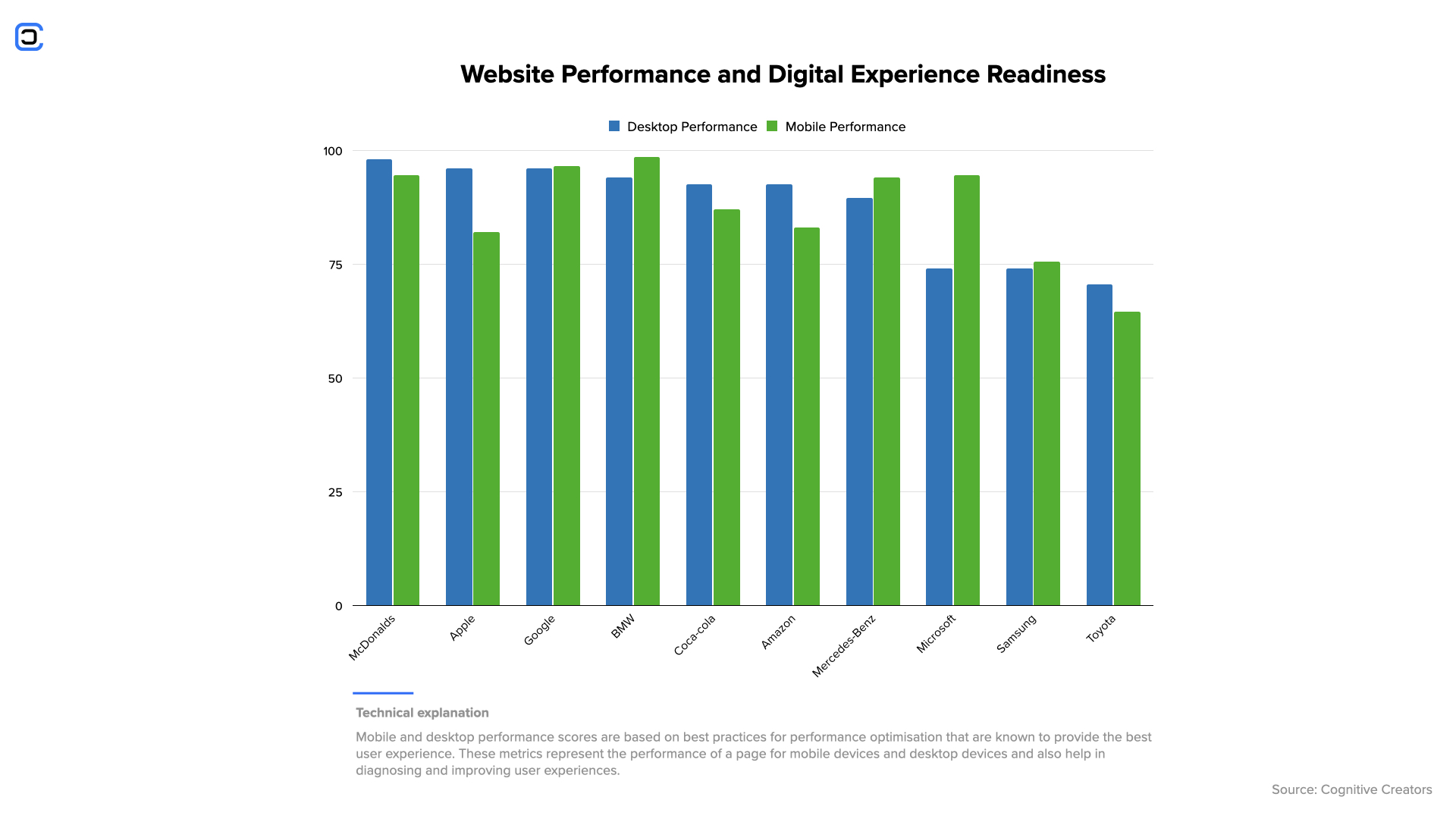
Once we turn to website performance, the picture becomes more interesting. Many top brands show strong mobile optimization, while others show a clear reliance on desktop strength.
What matters here is not the absolute score, but the signal it sends. Fast, accessible, standards-compliant websites communicate digital reliability and reduce user friction.
The opportunity this unlocks: when technical performance aligns with brand expectations, it strengthens the digital portion of brand value by lowering friction at every touchpoint.
This becomes even clearer once we examine how people search for and find these brands.
How Digital Popularity Evolves Over Time
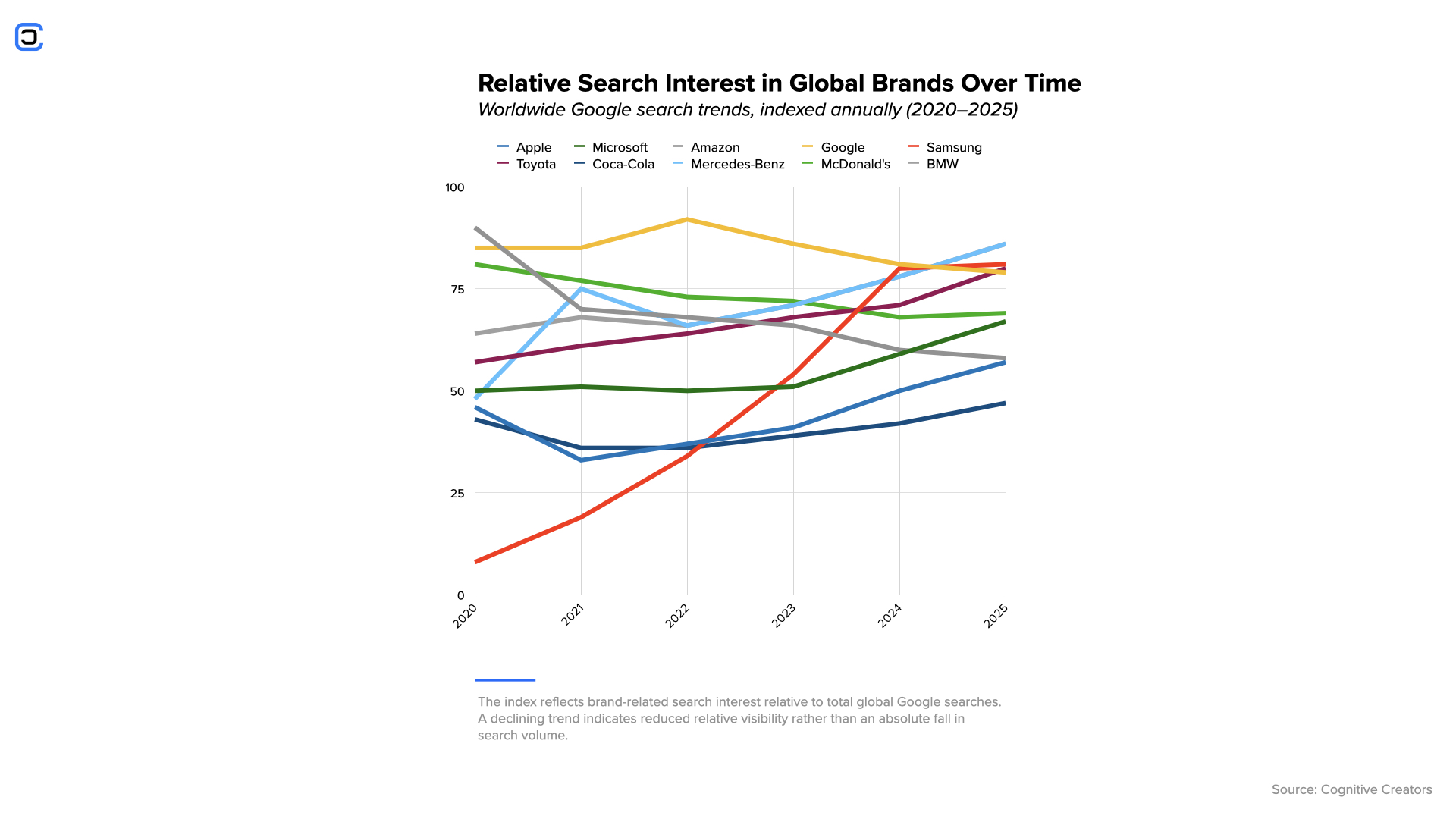
Search behaviour over the last decade shows long-term trajectories that differ by category. Tech ecosystem brands maintain stable or rising search interest because people need them daily (for updates, troubleshooting, services, and product information).
By contrast, experience-driven brands (fast-food chains, beverage companies, automotive icons) see quieter search volumes. Not because they are weaker, but because people already know how to access them. They don’t search for a beverage the way they search for a cloud service.
The signal here: digital relevance is shaped by the frequency and context of use. Brands used functionally generate continual search demand; brands used experientially generate cultural recognition but less search behavior.
And yet, the picture shifts again when we look at organic visibility.
Organic Visibility and Digital Market Share in Action
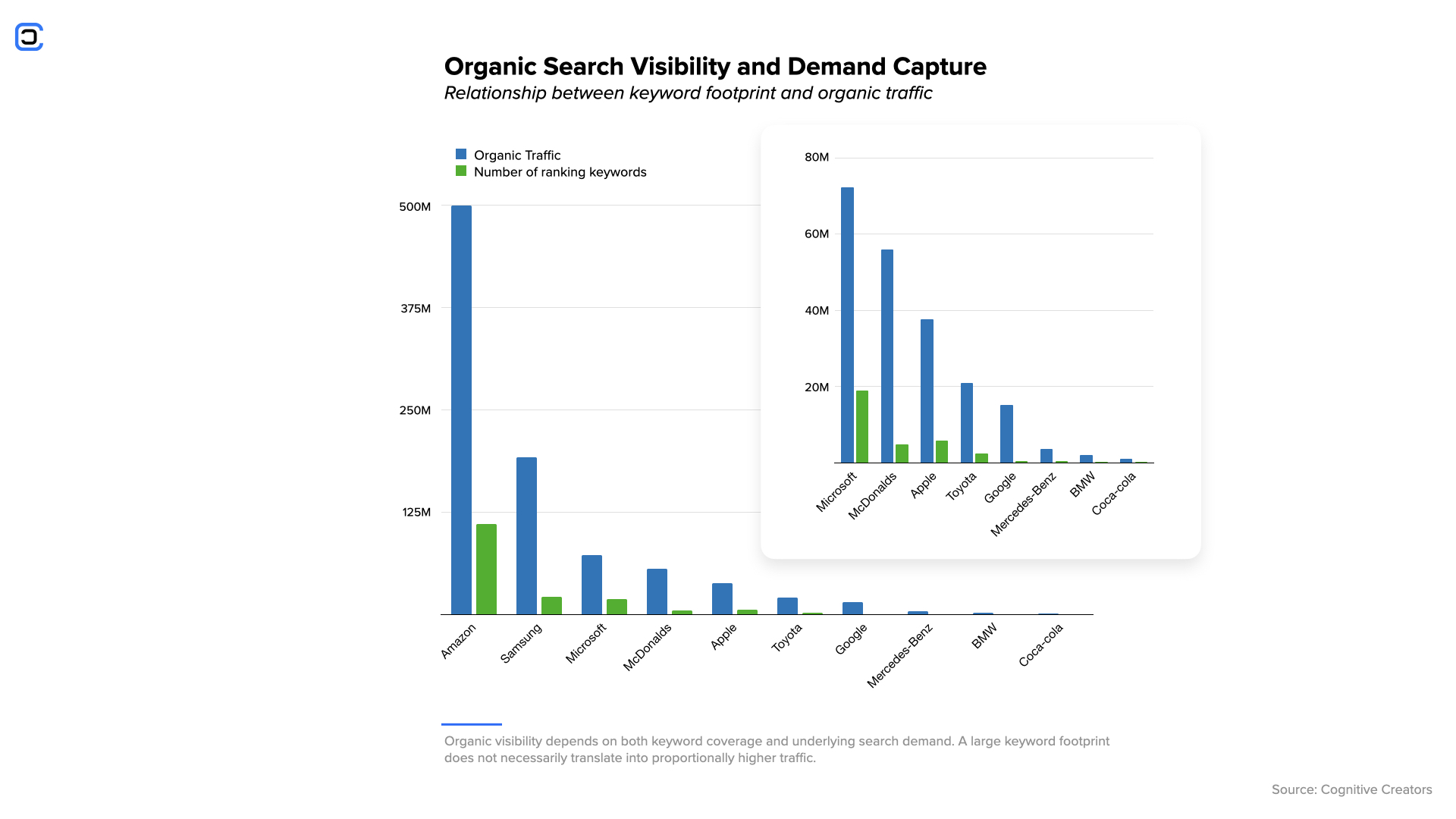
Organic traffic and keyword volume reveal the true scale of digital demand. Tech-centric brands naturally attract massive organic search ecosystems, millions of queries tied to features, help pages, services, and product variations.
Meanwhile, consumer goods and lifestyle brands, even globally iconic ones, generate far smaller organic ecosystems simply because their search cases are narrower.
The risk here is subtle: brands with limited organic visibility must rely more heavily on paid channels to stay top-of-mind, which can raise long-term acquisition costs and weaken the compounding effect of digital demand.
But visibility isn’t perception. For that, we look to sentiment.
Sentiment and Share of Voice
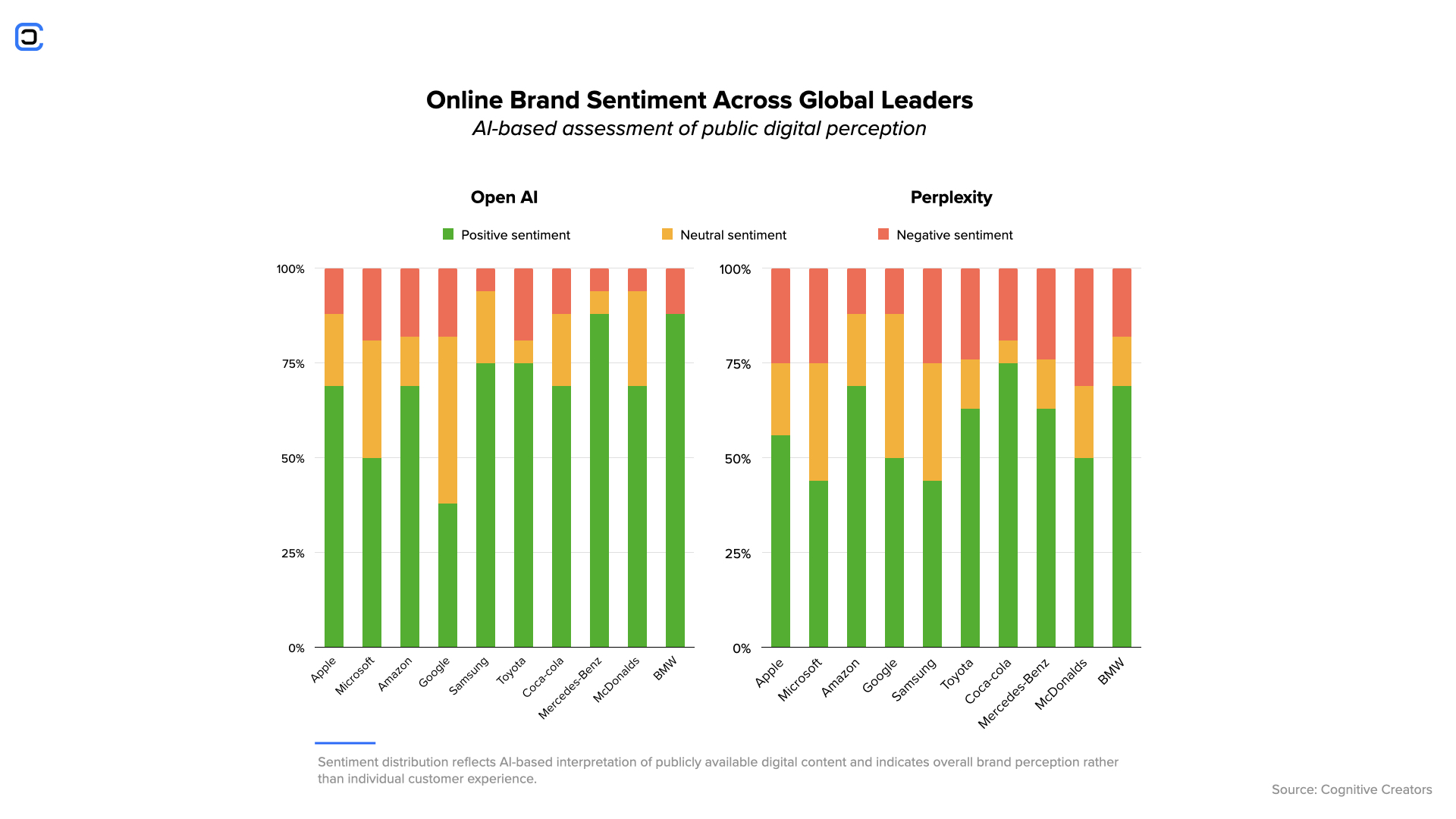
Sentiment analysis reveals an interesting contrast: many top brands enjoy extremely high positive sentiment, even when their digital footprint is smaller in scale. Conversely, brands used in functional, everyday routines often attract more neutral sentiment simply because interactions are transactional.
Share of voice adds another layer: brands tied to business ecosystems or technological workflows generate more digital conversation, regardless of consumer emotion.
This signals something deeper: reputation and attention operate on separate axes. A brand can be deeply trusted but lightly discussed, or widely discussed but perceived neutrally.
To understand digital brand value, these signals must be viewed together.
The Signal That Repeats Across All Layers
When all digital layers are viewed together, one insight consistently appears:
the most resilient brands are not those dominating each metric, but those showing steady, aligned strength across them.
Digital strength emerges from coherence, not spikes. A balanced profile across visibility, performance, discoverability, sentiment, and conversation signals a brand whose digital equity is structurally reinforced.
This is the underlying logic behind how digital brand value is calculated.
A Note on Digital Brand Value Calculation
This article illustrates the high-level logic and structure behind a digital brand value calculation. It does not disclose the digital brand values of the analysed brands.
If you are interested in accessing the full results, including each brand’s estimated Digital Brand Value, you canrequest it here.
What This Means for the Future of Brand Leadership
As digital ecosystems mature, the portion of brand value shaped by digital signals will grow. Digital presence and performance increasingly define how people interact with brands.
Digital brand value is on track to become a major indicator of future brand relevance.
For companies, this means digital due diligence is not just an analytical exercise, it is a strategic lens for understanding competitiveness. For investors, it becomes a way to identify which brands are positioned for long-term relevance and which may be over-reliant on legacy strength.
Digital Investment Literacy Index (DILI)
If you want to understand how well you interpret digital signals like these, you can try the Digital Investment Literacy Index (DILI): a short, free assessment that helps investors identify the digital factors that influence valuation, risk, and long-term performance. Developed by Cognitive Creators, DILI is an independent benchmark designed to help the investment community evaluate digital signals with greater confidence.
We’re curious in which car do you see yourself taking this roadtrip. If you need a helping hand figuring out the road to grow, check out our Consultancy services and don’t hesitate contacting us.
Explore the true potential of your digital endeavours
When was the last time you lost sight of a seemingly minor detail that kicked back? While thinking about it, check out how we can help you with uncovering the digital opportunities and risks that were not evident from the start.