Blink-and-you-miss-it: the digital sprint of Formula 1
This article takes you inside Formula 1's digital sprint to win the race for digital attention with Liberty Media's grand strategy.
Kinga Forró
Digital Business Analyst
‘On the starting grid’: The race of digital attention
"When it rained, I thought, this is it: I can win from fifth in the rain”, said Lewis Hamilton when recalling his 2017 Singapore Grand Prix triumph. Speaking of this victory years later, there's a truth about rain: it can bring luck, but it can also magnify the challenge of proficiency to show itself even more. The magic lies in the mix, in the story itself. Beyond the track, performance extends into storytelling; teams and their drivers embody values that translate into influence. And today, big moments no longer stay confined to the circuit. They are shared, remembered and celebrated.
Where can we step into the story? Where else: in digital.
Formula 1’s digital sprint immerses us in the ‘sports as media’ paradigm, becoming a global stage where technology, entertainment, and business converge. It has become a fashion phenomenon in every sense, both in terms of popularity and its ties to the fashion industry. F1’s visual language consistently serves as a creative reference for designers and drives brand collaborations, broadening its reach and attracting new audiences. Global online interest has grown by about 13.5% since 2020; much like the races themselves, it keeps finding another gear, strengthening the sport’s digital brand value and turning attention into measurable influence. Each year, more and more people search for it across all that is digital: Google, ChatGPT, or social media platforms, like Instagram or TikTok. This surge in online engagement is shaping the sport’s culture, sparking a global community. But it wasn't always this way. A decade ago, F1 was available only for ‘gold fans’ and car aficionados, with mainstream popularity far from the pole position. So what has changed? Let's explore this digital race from our perspective, especially as F1 celebrates its 76th anniversary in 2026.
‘The pace of popularity’: What does it mean to win in the digital era?
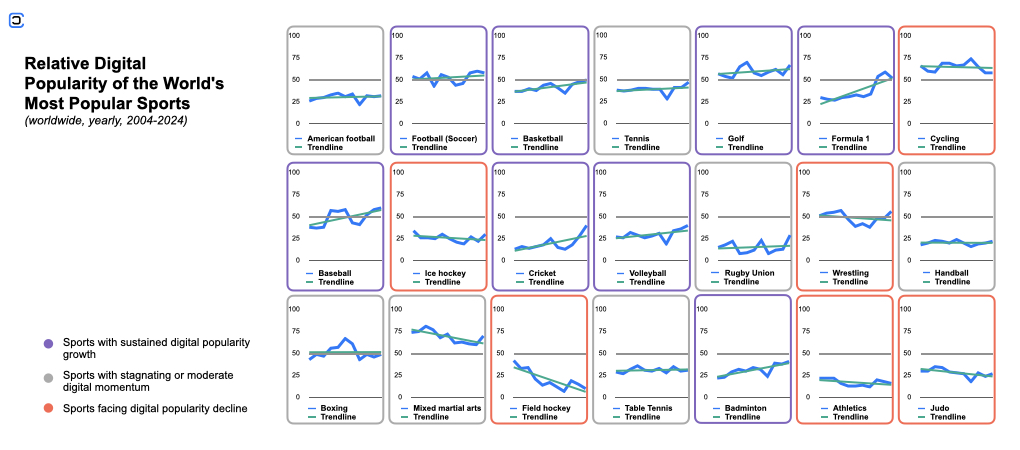
Winning in digital means counterbalancing the limitations of the analogue era. This is important because today’s digital-first audiences dictate trends on a global scale. The evolving digital popularity of 20 major global sports (from 2004 to 2024) illustrates how each has responded to this challenge. We can see that traditional sports like Football and Basketball remain favourites worldwide, showing sustained digital popularity growth. Conversely, some widely practised Olympic sports, such as Athletics, Field Hockey, and Judo, struggle to capture digital attention, with trendlines showing steady declines.
Formula 1, on the other hand, is living its renaissance, standing out as a remarkable case study with the steepest and most consistent growth trend. What began as a niche digital presence in 2004 has become a mainstream phenomenon by 2024. The turning point came in 2017, when Liberty Media acquired Formula One with a vision to showcase it in a fresh new light. This perfectly timed move set the stage for its strategic reinvention, supported by the expanded media partnerships, a longer race calendar, and strategic investments.
The curtain has risen, and since then, the show has been on display for a global audience.
‘Changing gears’: Liberty Media’s grand strategy
When Liberty Media took over Formula 1, the goal was to realign the commercial strategy, more actively involving the general public, particularly the younger generation. They sought to build on F1’s existing strengths while seizing new opportunities unique to the sport’s nature, shifting its emphasis toward lifestyle and entertainment. This move resulted in an increase of over 90% in annual revenue between 2017 and 2024. Even if speed has limits, digital doesn’t. And numbers are definitely doing the talking. Shortly, F1 became a high-value business with growing investor interest, tending to present a stable financial base and promising growth opportunities for teams. The investment value is driven not only by rising financial revenues but also by digital brand value, amplified through digital media initiatives and online fan engagement.
Regarding digital media initiatives, in general, F1 benefits from some structural advantages that allow its digital adaptation to be a ‘smooth operation’. A key point to mention is its centralised ownership under Liberty Media, which enables faster and more cohesive strategic coordination. With pre-scheduled races, the sport is also well-suited to be packaged digitally, and also, racing is often described as a sport best experienced on screen, where viewers can follow the action more comprehensively than in person.
Digital media delivers an anytime, anywhere experience, immersing fans in real-time telemetry, onboard camera angles, pit-stop strategies, and trackside footage. F1 operates its own proprietary streaming service, F1 TV, which gained significant popularity, seeing a 77.5% increase in search interest (2021-2025). The platform has quietly become a key digital touchpoint for fans around the world, offering unprecedented access to the strategic and technical depth of the sport.
However, traditional TV is also a popular channel. Through strategic investments in the US market, the sport has achieved significant growth in viewership and fan engagement in recent years. This means 1.4 million viewers on average per race across key local US TV channels. The Miami Grand Prix set a US viewership record in 2024 with 3.1 million viewers, followed by 2.2 million in 2025, still above the average.
Social media adds another digital dimension to online fan engagement, putting F1’s speed in perspective: blink-and-you-miss-it. Liberty Media ended the social-media-free era, easing the rules and allowing teams to share paddock clips and behind-the-scenes content from the Grand Prixs. Millions of people follow Formula 1 on various social media channels, and that number goes up by about 21% each year. The strong Instagram presence, reflected on a team level as well, underscores a strategic focus on leveraging the platform’s visual appeal and dynamic content-sharing capabilities, being well-suited for real-time community engagement.
‘The digital pit stop’: Inside F1’s new popularity engine
Why is F1 so attractive? Mapping the new compass of interest opens the door to exploring more of the F1-specific popularity factors at play.
Formula One is defined by its drivers, whose performance and character ignite both the sport and audiences worldwide. In many ways, they unite it all: from team strategy and firing up the engines to their own personal achievements. Fans are emotionally connected to them, which now extends into digital culture and creates viral moments. Max Verstappen, for example, even has his own themed song, which sees around 22,200 average monthly searches on Google. Iconic team radio clips also fuel digital interest. Every fan who hears “Smooth Operator” instantly recalls Carlos Sainz’s singing moment (I wonder if you, too, recalled it in the previous chapter); searches for it average about 4,400 per month, with a video record reaching an impressive 2.6 million views on YouTube. Lando Norris had his unforgettable radio check too – “It’s Friday then, it’s Saturday, Sunday... what?” – with one video of that exchange reaching 1.4 million views. Maybe it’s a coincidence, or maybe once a McLaren driver, always someone who knows how to pick the tunes.
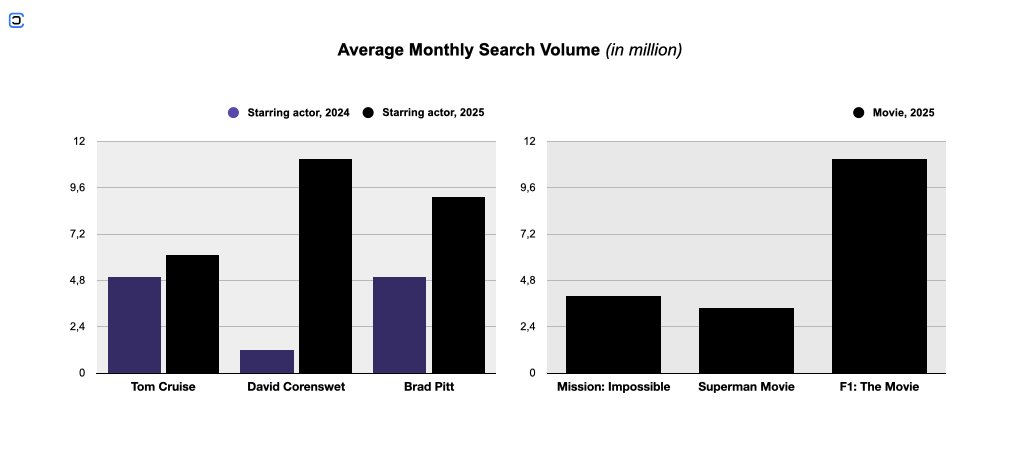
Audience curiosity about Formula 1 is also shaped by contemporary cultural influence and celebrity involvement. In this sense, F1 films are as much about the stories on-screen as they are about the off-track narratives. Star power acts as a strong attractor, a phenomenon commonly observed in the sports world. As seen in Formula 1, high-profile drivers draw attention to their teams, or in football, leading players shape the popularity of their clubs. The recent Brad Pitt-led Formula 1 film, F1: The Movie, recorded a global monthly search volume of over 11.1 million in July 2025 (for the keyword ‘f1 movie’). By comparison, the new Mission: Impossible film starring Tom Cruise garnered 4 million searches, while Superman with David Corenswet attracted 3.35 million searches (for the keyword ‘superman movie’) during the same period. It’s never just about the story of the film, but also about the actors playing it. So there appears to be a connection between the star power and the relative popularity of the films, particularly when associated with a widely appealing theme. During this period, searches related to the main actors were higher compared to the same timeframe last year.
Netflix has taken F1’s popularity to a next level with its documentary series, turning the sport into a storytelling-first narrative product. Since 2019, Drive to Survive has been bringing fans behind the scenes of the sport. It is very popular, achieving 31% growth in public interest over the last five years, particularly boosting F1’s popularity in the US, where average TV viewership per race increased by 67% since its debut. In 2024, Senna also debuted on Netflix, offering a deep dive into the life of the legendary driver. The series generated significant online interest. Drive to Survive averaged around 110,000 monthly searches in June 2025. Keywords referencing the specific seasons attract between 20,000 and 30,000 searches, while combined terms like “F1” and “Netflix” add another 10,000 per month. Senna (2024) generated 127,000 searches for the “Senna Netflix” keyword. Although these numbers are smaller compared to featured movies, they likely reflect different search behaviour, as fans are less inclined to search for the series on Google, instead engaging directly through Netflix.
‘The chequered flag’: Lessons from F1’s digital sprint
If a name is a promise, then F1 must have its own formula that explains its digital success, teaching us not just about speed, but also about storytelling and fan connection as key drivers of digital popularity. When one investigates the roots of a success strategy, it quickly becomes clear that even if a vision is big, it doesn't have to be heavy. And digital is the best area for this to achieve.
Liberty Media's digital expansion efforts broadened the sport’s global reach, simultaneously unlocking new revenue streams essential for long-term growth and investment value. The new-era appeal carries within itself a fresh timelessness that brought fans closer to the dynamics of F1, turning engagement into an ongoing conversation. Beyond following the races, audiences now expect immersive and authentic digital experiences that reflect the intensity and innovation of Formula 1 itself. What does not evoke emotion, does not make the heart race. And one of the key roles of digital media, films, or documentaries is to capture the drama, continue the story, and carry it far beyond the chequered flag.
Consumer behaviour is ever-evolving, and brands must find ways to adapt. How to keep the momentum going when this race never really ends? Be it a topic for further discussion.
We’re curious in which car do you see yourself taking this roadtrip. If you need a helping hand figuring out the road to grow, check out our Consultancy services and don’t hesitate contacting us.
Explore the true potential of your digital endeavours
When was the last time you lost sight of a seemingly minor detail that kicked back? While thinking about it, check out how we can help you with uncovering the digital opportunities and risks that were not evident from the start.